

Riyana Patel
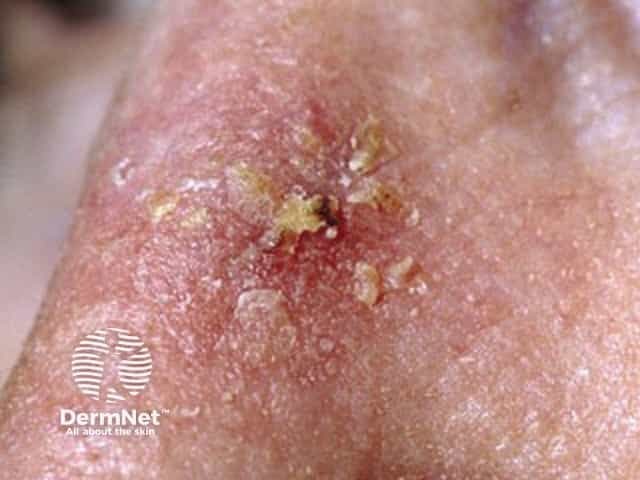
Actinic keratosis, or solar keratosis, is a precancerous lesion caused by UV damage to the skin.
Who does it affect?
Actinic keratoses can affect virtually anyone; however, certain risk factors may increase the chance of developing these precancerous lesions. These risk factors include, but are not limited to, having an extensive history of sun exposure or sunburns, living in a sunny environment (tropics, subtropics, etc.), working outside, and having a weakened immune system.
What causes actinic keratoses?
The main cause of actinic keratosis lesions is oftentimes frequent or intense sun exposure either through natural UV rays or tanning beds. These lesions are slow-growing and are considered to be precancerous because of their potential to develop into a squamous cell carcinoma. If caught early, there are a variety of different treatments that can help stop this progression.
How is it treated?
There are a multitude of different treatment options including cryotherapy, field therapy, excision or shave, electrodessication and curettage. Each of these treatment options are explained in further detail below.
Field treatments target visible and developing sunspots on a large area (ex. face, scalp, or both) of the body. There are different modalities used for field treatment including photodynamic therapy (PDT), imiquimod cream, or fluorouracil 5% cream.
- Photodynamic therapy is also known as blue light therapy and is mainly used for treatment of the face, ears, neck and scalp. The procedure starts with applying aminolevulinic acid gel. After absorbance of the gel, the treated areas are exposed to blue light for approximately 1,000 seconds (16 minutes and 40 seconds). The aminolevulinic acid gel makes actinic keratoses extremely sensitive to light. Therefore, any sun-damaged cells would be destroyed during the process.
- Fluorouracil 5% cream (5-FU) is a cytotoxic topical treatment for these precancerous lesions. This cream is prescribed in combination with calcipotriene 0.005% cream, which enhances the effectiveness of the treatment and decreases the treatment duration. The combination cream treatment is commonly prescribed twice daily for 2 to 6 weeks depending on the target area and prescriber discretion.
- After undergoing treatment many patients will experience mild to exuberant reactions at the target areas, pictured below.

- After undergoing treatment many patients will experience mild to exuberant reactions at the target areas, pictured below.
- Imiquimod cream is an immune response modifier topical treatment often used for clearance of actinic keratoses. Similar to fluorouracil 5% cream, this treatment modality is quite successful in decreasing reoccurrence of actinic keratoses at treated areas. This cream is frequently used three times a week over the span of three to four months.
Cryotherapy is another approach for destroying these types of lesions. This process includes spraying liquid nitrogen for 5 to 20 seconds on the point of concern. Predominantly, this treatment is favored when treating individual, visual actinic keratosis lesions. Liquid nitrogen treated points will blister, swell, and appear red. However, these symptoms often subside after approximately 7-10 days.
Excisions can be performed on actinic keratoses but leave a permanent scar. This treatment ensures that the entire lesion has been removed using a surgical blade under local anesthesia. This treatment is primarily preferred when there is an isolated lesion of concern. After the procedure, the specimen diagnosis will be confirmed with pathology.
Lastly, shaving, electrodessication and curettage can be performed on singular actinic keratosis lesions. This is a small in-clinic procedure that includes shaving of the lesion, curettage (scrapping) at the base of the lesion and electrodessication (burning). Oftentimes, the healing process after this operation is much longer and most likely will leave a permanent scar.