

Riyana Patel
Different Types of Psoriasis
Psoriasis generally presents as scaly thickened areas of the skin. However, there are different types of psoriasis affecting various areas of the body including the scalp, nails, palms, and soles with different presentations. Psoriasis can be localized or generalized, which differ in treatment rationale.
Plaque Psoriasis
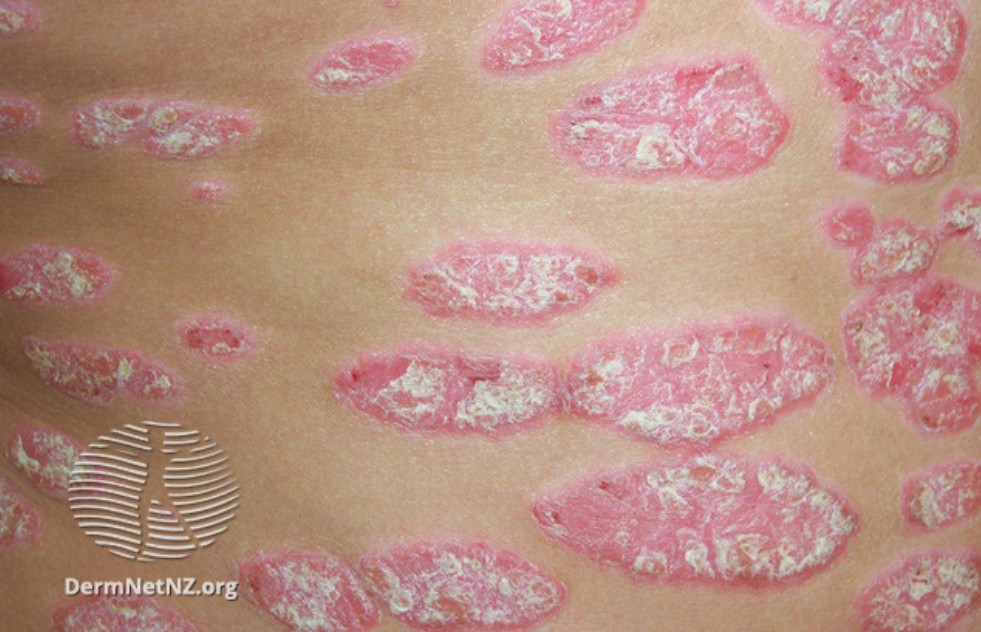
The most common type is plaque psoriasis that presents as well-demarcated plaques of thickened, scaly skin. It most likely affects elbows, knees, and lower back but may arise on any part of the body. Plaque psoriasis can also affect the palms and soles, referred to as palmoplantar psoriasis. This can occur as localized palmoplantar psoriasis or as part of generalized psoriasis.
Inverse Psoriasis
Inverse psoriasis, sometimes referred to as flexural psoriasis, is psoriasis localized to the skin folds (e.g. armpits, groin, under breasts) and genitals. Instead of the scale usually associated with plaque psoriasis, it tends to present as shiny and smooth. There may be a crack in the depth of the skin crease.

Nail Psoriasis
Nail psoriasis is commonly associated with plaque psoriasis, affecting 90% of patients with chronic plaque psoriasis at some point in their lifetime. It is characterized by pitting, onycholysis, yellowing, and ridging of the fingernails and/or toenails.

Guttate Psoriasis
Guttate psoriasis presents as small “raindrops” of red, scaly skin, hence the name guttate deriving from “gutta” meaning drop. It is a form of acute psoriasis and usually clears within 3-4 months. However, persistent guttate psoriasis may develop into chronic plaque psoriasis.
Pustular Psoriasis
Pustular psoriasis is a more rare type of psoriasis, and is most. It causes reddish, scaly, pus-filled bumps. Patients who have generalized pustular psoriasis should seek immediate attention as widespread pustular psoriasis can be life-threatening.

What causes psoriasis?
Psoriasis is an immune-mediated inflammatory disease. It is a multifactorial condition with different factors contributing to its presentation including genetics, comorbidities such as obesity and metabolic syndrome, and lifestyle choices such as smoking and stress. The pathways leading to psoriasis and its clinical presentation are still being explored, but it is clear that immune factors and cytokines are responsible for the clinical features of psoriasis. Currently, it is known that IL1β and TNFα are two cytokines involved. Theories are also exploring the roles of IL17A and the TH17 pathway in psoriasis. Because of the inflammatory and immune-mediated response associated with psoriasis, patients with psoriasis often have psoriatic arthritis in conjunction.
There are additional triggers for the various types of psoriasis. Guttate psoriasis often develops 1-2 weeks after a streptococcal infection of the upper respiratory tract, particularly tonsillitis. It has also been reported to develop after COVID-19 infection. General pustular psoriasis can occur in pregnant women triggered by changes in hormone, calcium, and elafin levels on a predisposing genetic background.
How is psoriasis treated?
Treatment options vary widely depending on the severity of your condition, your work environment, and your lifestyle. At DermCare Experts, we are committed to finding the best treatment plan tailored to every patient after understanding and assessing your individual needs. We treat atopic dermatitis with the most up-to-date knowledge and access to the most recent therapies as well as cutting-edge clinical trials which pay you for your time and effort.
Over-the-counter medications can be used to treat mild cases of psoriasis and maintain clearance
- Emollients are recommended for all psoriasis patients to prevent painful cracking and scaling
- Keratolytic agents such as urea or salicylic acid is recommended for palmoplantar psoriasis to thin down the thick scaling skin
- Coal tar has anti-inflammatory and anti-scaling properties to thin down thick scale. This is especially useful for scalp psoriasis to allow medicated shampoo and other topical medications reach the scalp.
Prescription topical medications are also be used to treat mild and localized psoriasis
- Topical steroids which vary in strength (e.g. mometasone, betamethasone, clobetasol) to reduce inflammation and cut down on itch
- Vitamin-D like compounds (calcitriol and calcipotriene) as the first line of therapy and for maintenance
- Calcineurin inhibitors (ie. tacrolimus or pimecrolimus) especially in sensitive areas like the face or skin folds where long-term use of topical corticosteroids is not indicated
- New topical medications are available that targets new;y discovered pathways
- Roflumilast (Zoryve®) newly approved by FDA in July 2022 that is a PDE4 inhibitor
- Tapinarof (Vtama®) newly approved by FDA May 2022 that is an AhR modulating agent
Systemic treatments to treat generalized psoriasis that is inadequately controlled with topicals
- Biologics are among the most advanced available today for atopic dermatitis. They are synthesized from living organisms and target very specific protein receptors. These medications are administered as a subcutaneous injection
- TNFα inhibitors: etanercept (Enbrel®), adalimumab (Humira®), and certolizumab (Cimzia®)
- IL-17 agents: secukinumub (Cosentyx®), ixekizumab (Taltz®), and brodalumab (Siliq®)
- IL-12 and IL-23: ustekinumab (Stelara®), guselkumab (Tremfya®), and risankizumab (Skyrizi®)
- Oral medication apremilast (Otezla®), a PDE4 inhibitor
- Oral medication deucravacitinib (Sotyktu®) newly approved by the FDA in September 2022, a small molecule compound that targets tyrosine kinase 2
- Traditional systemic medications that suppress the immune system (ie. methotrexate, ciclosporin)
- Oral retinoid acitretin (Soriatane®)
- Phototherapy with narrowband UVB or a combination of psoralen and UVA
Most of the treatments above are indicated for plaque psoriasis. There are some treatments available that are indicated only for other types of psoriasis
- Spesolimab-sbzo (Spevigo®) newly approved as the first approved treatment for generalized pustular psoriasis flares in adults
In addition to the therapies currently on the market, there are more treatment options undergoing efficacy and safety assessments through clinical trials. We have a robust clinical research arm in our affiliated research site that conducts Phase II-IV trials on psoriasis. Studies include novel therapies for psoriasis as well as Phase III and Phase IV studies assessing efficacy of medications already available on the market. If you are interested in participating in our clinical trials, please inquire with your doctor or visit Beacon Clinical Research for more information.